
Many small businesses believe one simple thing:
“We have antivirus. We are safe.”
Unfortunately, that belief is one of the biggest cyber risks today.
Let’s break this down in plain, non-technical words — no IT jargon, no fear tactics.
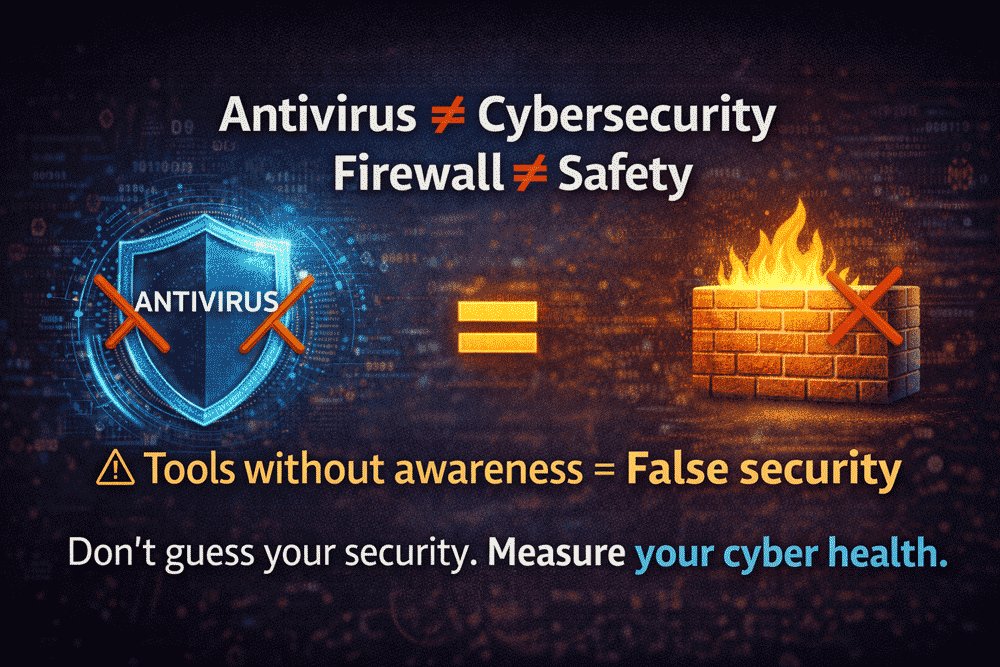
❌ Antivirus ≠ Cybersecurity
Antivirus software is like a lock on your front door.
It can stop some known threats.
But it cannot:
- Protect your employees from phishing emails
- Save your data if your laptop is stolen
- Recover your business after a ransomware attack
- Stop human mistakes
Cybersecurity is much bigger than one tool.
❌ Firewall ≠ Total Safety
A firewall is helpful.
But a firewall alone is like a fence around your house with the windows open.
Most attacks today don’t break in through servers —
they come through:
- Weak passwords
- Fake emails
- Untrained staff
- No backups
- No recovery plan
If one employee clicks the wrong link, no firewall can save you.
⚠️ Tools Without Awareness = False Security
This is where most businesses get it wrong.
They buy tools…
but never check:
- Do staff know how attacks happen?
- Can we recover data quickly?
- Who is responsible during an incident?
- Are passwords reused everywhere?
Without awareness and planning, tools only look like protection.
That’s called false security.
✅ Real Cyber Safety = Awareness + Readiness
True cyber safety comes from:
- Understanding your risks
- Knowing your weak points
- Training people
- Preparing for recovery
- Measuring your cyber health regularly
Not guessing.
Not assuming.
Not trusting tools blindly.
🔍 Where Do You Really Stand?
That’s why smart businesses are moving to cyber health assessments —
simple checks that show how safe you actually are, beyond antivirus and firewalls.
Because cyber risk doesn’t announce itself.
It strikes when you’re unprepared.
🚀 Final Thought
If your business stopped for one day because of a cyber issue —
could you recover?
If you’re unsure…
it’s time to measure, not guess.